A compiler turns source code into machine code so a computer can run it
When you want to compile source code into machine code you will need to translate the source code into assembly code and then into machine code.
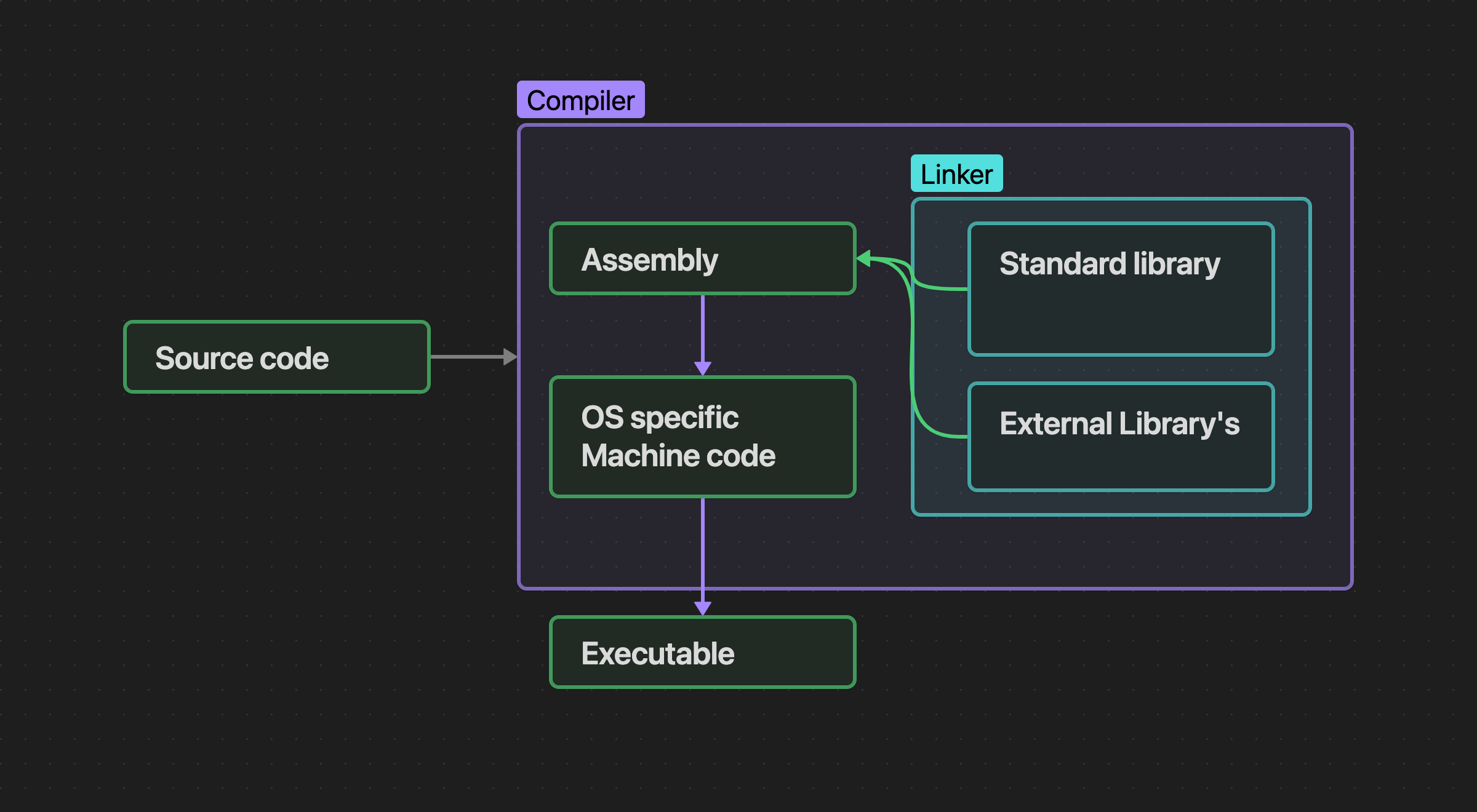 Image source
When a program is compiled it is only compiled for that machine architecture and is hard to read as a human.
Example
In this example we are going to compile a simple C program into x86_64 assembly.
Source code:
int main() {
	int x = 1;
	int y = 2;
	return x + y;
}
Assembly:
main:
	push rbp
	mov rbp, rsp
	mov DWORD PTR [rbp-4], 1
	mov DWORD PTR [rbp-8], 2
	mov edx, DWORD PTR [rbp-4]
	mov eax, DWORD PTR [rbp-8]
	add eax, edx
	pop rbp
	ret
Compilers
- C:
- C++:
- G++ (GNU Compiler Collection)
- Clang++
- Visual C++
- Java:
- [[Csharp|C#]]:
- Roslyn (Microsoft’s .NET Compiler Platform)
- Swift:
- Swift (Apple’s Swift Compiler)
- Rust:
- Objective-C:
- Clang (supports Objective-C)
- Go:
- Fortran:
Code optimisation
A compiler can optimise the code by reducing the amount of code that is needed to run.
For example
int main(){
	int x = 1;
	int y = 2;
	return x + y;
}
int main(){
return 3;
}When this program is compiled it will always return 3. To reduce the amount of commands being run on the CPU we can calculate results and remove unnecessary code. This will also reduce the size of the binary.